Comforted by a loan sanction pipeline of Rs 1.29 lakh crore and having taken several deposit mobilisation initiatives, Punjab National Bank managing director and CEO Ashok Chandra is confident that he would be able to achieve the full-fiscal growth target for these two core pillars of banking.
Chandra, who heads India’s second-largest state-owned bank by market value, has guided for a 11-12% growth in credit and a 9-10% rise in deposits in FY26 over the previous financial year. The bank’s total business, which jumped 11.6% to Rs 27.19 crore as of 30 June, is expected to cross Rs 29.5 lakh crore by the end of the current financial year.
Despite loan growth falling marginally below double digit in the fiscal first-quarter, Chandra expects a faster pick up from September-end due to festive season and transmission of lower lending interest rates.
“We have new loan sanctions this year and old ones carried forward, leading to a combined pipeline of Rs 1.29 lakh crore. The credit offtake in the June quarter has not happened to the extent that we had expected but disbursals should step up towards the end of second quarter,” Chandra said, replying to a query by www.indianbankingnews.com.
In the first quarter of the current financial year, PNB’s global advances rose 9.8% year-on-year to Rs 11.30 crore, which is just below what Chandra had set out to achieve. While the demand for credit was muted for the banking sector as a whole, Chandra also decided to shed low-yielding advances even as the focus was on keeping the operating profit high.
For the revival of business loan growth, Chandra expects demand to spring from infrastructure, smart metering, renewable energy projects, real estate and data centres.
The bank's corporate loan book, which makes up nearly 43% of the asset portfolio, grew 6.9% year-on-year to Rs 4.68 lakh crore at the end of June. While the retail loan book grew 11.8% to Rs 2.62 lakh crore, MSME loans were up 18.6% to Rs 1.69 lakh crore and agriculture 6.2% to Rs 1.78 lakh crore.
Chandra’s aim is to increase the RAM (retail, agri and MSME) portfolio from around 56.5% to at least 59-60% of the bank’s total loan book. In July, the bank organised a mega retail outreach programme at over 130 locations across the country under the theme ‘Many dreams, one destination’.
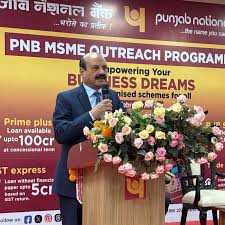
There has also been an aggressive drive to grow the MSME (micro, small and medium enterprises) book through outreach programmes across the country, where the CEO himself has been present at several venues. The bank has also revamped multiple MSME products to better align with customer need and suitability.
On the deposit front, PNB has crossed the target in the first quarter with a year-on-year growth of 12.86% to Rs 15.89 lakh crore.
The low-cost CASA (current account savings account) share in the total deposit mix stood at 36.99% as on 30 June, as against the guidance of 38% by the end of the fiscal. Chandra has revamped the CASA products portfolio in April and expects to reap dividends during the course of the year.
Chandra expects the bank’s profitability for the full-fiscal to be around the same level as FY25, despite a 48% year-on-year slump in net profit to Rs 1,675 crore in the first quarter ended June due to a one-time deferred tax of Rs 3,324 crore.
“Going forward, the migration to the new income-tax regime will help the bank. This was the right time to move and it is only a one-time quarter impact,” he said.
PNB had reported a net profit of Rs 4,567 crore in the preceding March 2025 quarter while in the year-ago period it was at Rs 3,252 crore. The bank expects to make up in the remaining three quarters of the current financial year. For FY25, the lender’s net profit was Rs 16,630 crore.
Chandra said barring net profit, the other key parameters, including operating profit and asset quality, have delivered in the April-June quarter. The bank’s quarterly operating profit touched a new high of Rs 7,081 crore, aided by income from treasury and loan recoveries. This was 28% higher than the year-ago period.
Chandra said the bank is on track to reach its gross non- performing assets (NPA) ratio target of below 3% in FY26, which will be the lowest ever for PNB. The gross NPA in the fiscal first quarter ended June stood at 3.78%, declining from 3.95% in the previous three months and 4.98% a year ago. Net NPA was at 0.38% versus the guidance of 0.35% for the year.
Chandra also said the bank would be able to achieve the recovery target of Rs 16,000 crore from bad loans. In the first quarter ended June, total recovery stood at Rs 3,356 crore.