


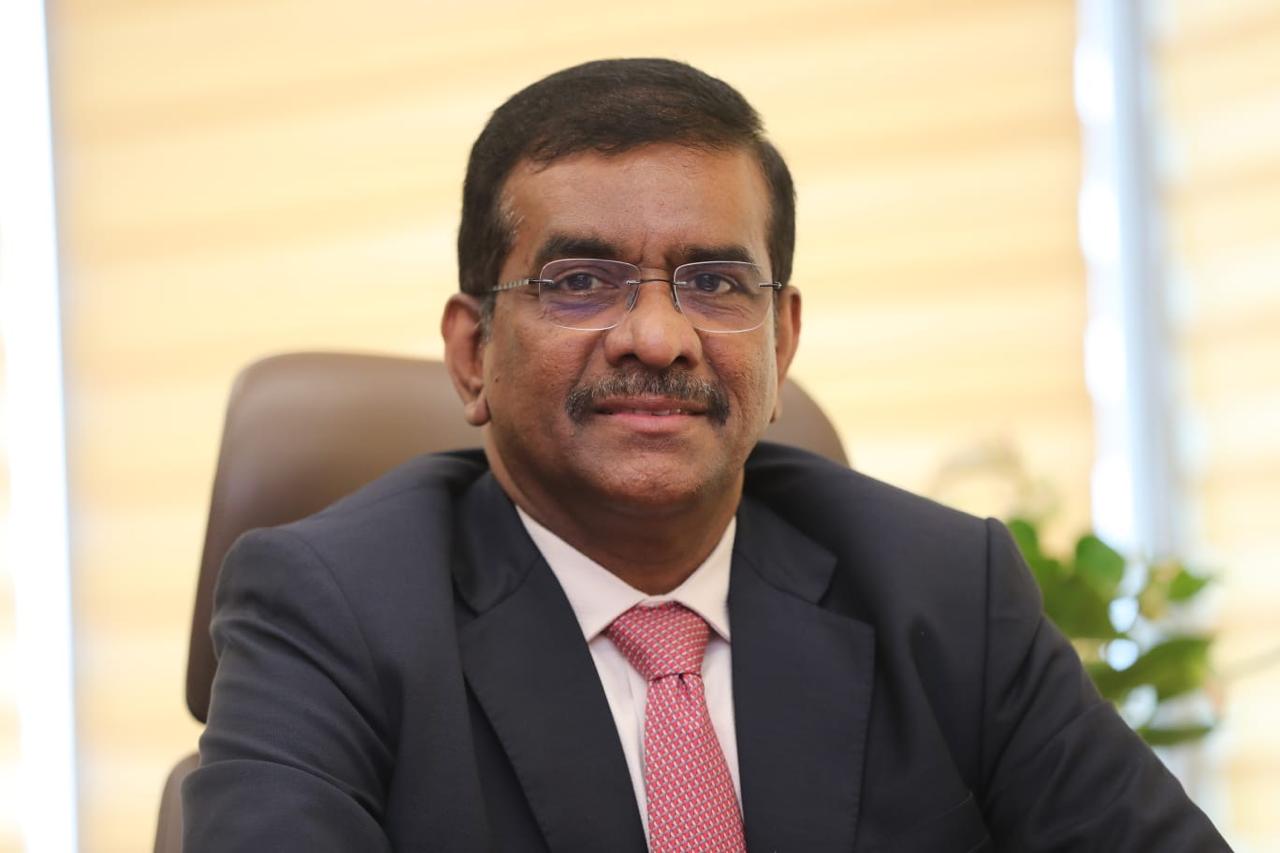
Rajkiran Rai loves to be on a mission. During his reign as Union Bank of India managing director and CEO, Andhra Bank and Corporation Bank came under his umbrella and he made the consolidation process a frictionless transition.
Now as the first managing director of National Bank for Financing Infrastructure and Development (NaBFID), Rai has taken up the challenge of providing not just long-term infrastructure finance but also developing an ecosystem to strengthen the domestic bond and derivatives markets.
In an interview with Indianbankingnews.com Editor Manju AB, Rai talks about NaBFID’s challenges to meet the huge infrastructure financing needs of the world’s fastest-growing economy in sectors such as power and roads. Appetite for funding is coming from new areas like data centres where India is replacing Singapore as the world's fastest-growing data centre due to the cost advantage, he says.
Rai also talks about US tariffs and how the Reserve Bank of India’s (RBI) new guidelines on partial credit enhancement can have a healthy impact on infrastructure sector bond issuances.
Here are the edited excerpts from the conversation.
How does it feel like moving from the head of a public sector bank to leading a specialised infrastructure financing company?
In my earlier assignments, I was part of state-owned banks which were already established much before me. Here I had to start from scratch and was given the responsibility of building an institution that would fund the infrastructure requirements of the world’s fastest-growing economy.
It has been a new journey not just for me but for the company as well. NaBFID was set up in 2021 by an act of Parliament and the board was constituted with KV Kamath as the first chairperson. I joined in August 2022 and the first loan disbursement was made in December of that year.
What was the mandate given to you?
The task is not just to provide long-term finance for infrastructure projects. The mandate is also to develop the ecosystem by strengthening the domestic bond and derivatives markets.
When you started, how difficult was it to get the right team as development finance institutions (DFIs) like IDBI and ICICI were disbanded and converted into universal banks?
NaBFID is into an area where specialised institutions are not there in India. We are also different from the earlier DFIs like IDBI and ICICI in the sense that we are just into infrastructure. IIFCL (India Infrastructure Finance Company Ltd) is still there but the others including IDFC Ltd (Infrastructure Development Finance Company) have transformed into banks.
Banks, however, have project finance specialists and we have got some of them here.
Was the funding gap in infrastructure left wide open because the DFIs had disappeared pre-maturedly?
India’s economy is in a high-growth phase and infrastructure development requires heavy investments. In just three years since we started our first sanctions, we have approved 232 projects amounting to Rs 2.31 lakh crore. Our disbursements are at Rs 85,000 crore, out of which the outstanding loan book is at Rs 65,000 crore as some repayments have come.
Corporate loan growth has actually been subdued for the last several quarters despite bigger banks boasting of a rich pipeline of sanctions. Are we seeing disbursements take longer than usual even in infrastructure financing?
We are not seeing any abnormal time lag. Since half of our loan book is towards greenfield projects, there is a typical three-year period between sanctions and complete disbursements. Ramping up the loan book overnight can’t happen as credit is availed in stages over a longer stretch. In our kind of business where disbursements take time, it is essential to have a robust pipeline of projects, both on the appraisal as well as on the sanctions side.

What is the loan target for FY26?
We are looking to do Rs 1.2 lakh crore of fresh loan sanctions in the current financial year, taking the total to Rs 3 lakh crore. The loan outstanding book should touch Rs 1.15 lakh crore by the end of FY26.
Will US tariffs of 50% on goods from India impact NaBFID’s loan growth?
Infrastructure as a sector has domestic orientation, both in terms of suppliers as well as users, making it largely insulated of global developments. Nevertheless, trade headwinds could have second order effects by impacting overall demand in economy as well as supply of intermediate goods and capital goods, which make key input to infrastructure development. From the NaBFID's portfolio perspective, we don't see any effect of India's tariff situation vis-a-vis the US.
A major chunk of the loans is coming from road and power sectors. Are we going to see a more diversified portfolio this year?
We have funded other sectors like ports, warehousing, data centres, hospitals and urban local bodies but it is roads and power which require heavy investments at this stage. About 70% of our loan book is from these two sectors. While they are currently equally split, we expect the power sector to overtake roads and become 40% of our loan book by the end of the fiscal. There has been a slowdown in the roads sector from its brisk pace last year, but we see it picking up now.
What is the current funding break up between these two sectors?
Our sectoral exposure towards roads is Rs 79,648 crore, or 36% of total sanctions, as of 30 June 2025. In the renewable and conventional power generation sectors, our exposure is Rs 57,361 crore (26% of total sanctions) and Rs 22,238 crore (10%), respectively.
Are you seeing more fresh demand coming from renewable energy?
We are seeing funding appetite come from both renewable energy and thermal power plants, which include power transmission and generation. There is also the trend of setting up hybrid models consisting of wind, solar and battery.
Are thermal projects more from NCLT cases where ownership has changed hands?
Not necessarily so. In any case, the new owners are financially stronger and there is no harm in refinancing such projects.
What is the biggest challenge in growing a credit market for infrastructure?
Commercial banks have asset-liability mismatch issues as infrastructure requires long-term funds. We do not face that problem and have elongated the loan tenure period. Out of our total pipeline, we have sanctioned Rs 1.75 lakh crore of loans across 162 infrastructure projects with a tenure of over 15 years. This is over 70% of our total loan book.
One of the biggest successes of this institution has been to extend the tenure of loans, which range from anywhere between 10 years to 35 years. What we are doing is matching the cash flows with long-term debt so that there is no strain.

India has emerged as one of the fastest-growing data centre markets in the world. What role is NaBFID playing in this?
India is replacing Singapore as the world’s fastest-growing data centre due to the cost advantage. A data centre in India can be set up at half the investments of what one would have to do in Singapore.
Fueled by cloud computing, artificial intelligence (AI) expansion and digitisation drive, hyperscale data centres are being developed. They are attracting major investments from global giants such as Google, Microsoft and Amazon.
India is rapidly emerging as one of the leading data centres of the world. Data centres are huge absorbers of credit and we see a big market opportunity is this. All the top players are our customers and our exposure to the sector as of 30 June 2025 is Rs 8,729 crore, or 4% of total sanctions.
While Mumbai and Chennai have a natural advantage because of undersea cable landing points, Bengaluru and Hyderabad have become big data centre hubs. Noida is also becoming a destination because of the government providing several incentives.
You earlier spoke of developing the ecosystem as being one of your mandates. What exactly is the role laid out for this?
NaBFID has a financing function and a developmental role. Our goal is to nurture an ecosystem which encourages crowding in of domestic and foreign investments into the sector. The development of the bond and derivatives markets for infrastructure financing is also part of my role.
Since we have an expert team, we have started offering specialised project finance advisory services. For starters, we have inked an agreement with Andhra Pradesh Capital Region Development Authority (APCRDA) to provide strategic advise to help them to design innovative financing models for key infrastructure projects in capital city Amaravati.
How do you bring in a wider pool to invest in long-term projects like pension and insurance funds?
India is growing big on insurance and pension funds. Though their assets under management (AUM) is around Rs 120 lakh crore, they have limited their investment avenues to government instruments.
The long-term funds that are investing in India are the foreign pension and insurance funds. They are putting their money behind hospitals, renewable energy and other sectors and capturing the returns. The challenge is to create an ecosystem that will give confidence to the Indian pension and insurance funds to feel safe to invest in long-term infrastructure bonds.
How do you develop the bond market?
For the bond market to deepen and be more liquid, we need to have more and more participants. Despite many efforts, the bond market has got restricted to the triple-A rated companies and government securities. The money from the bond market has never really flown into infra-related sectors.
We have done about Rs 6,000 crore of investments into the bond market. We have started helping the municipalities raise money through bond issuances. But more action is needed from everyone.
How will RBI’s new guidelines on partial credit enhancement help?
This has been there since 2015 but had no takers as it was not commercially viable due to the 20% cap on credit enhancement. But the new guidelines have lifted the exposure limit to 50% of the bond issue size. Along with some other revisions, the partial credit enhancement facility will make it easier for companies below triple-A rating to lower their cost of borrowing.
When NaBFID, for instance, provides credit enhancement, the infrastructure company’s ratings to the bond issuance gets upgraded and it can raise money from the market at a cheaper cost. If it decides to pay off the bank loans from the proceeds, it will free up bank limits. Funding can then open up for new greenfield projects and more companies will be encouraged to tap the bond market rather than rely solely on bank loans.
The bond market will thus be activated and there will be more and diversified issuances. The secondary bond market will also come into life.
Do you see NaBFID’s loan book growth slow down after the funding for road and energy sectors mature?
For the initial five years, we may go heavy on roads and energy assets because there is a need gap. But there will be new sectors that will require huge investments.
The government has already declared its ambition to become a global shipbuilding and maritime hub. This is set to drive the next phase of investments. There is a lot of urban infrastructure to be created as well, like waste management, water treatment plants and social mobility projects. This will require investments and financing support.
NaBFID needs to grow its capital base. Have you firmed up plans to raise funds overseas in FY26?
We are looking to raise up to $1 billion through external commercial borrowings (ECB). This will be our first overseas borrowing.
We are not sure how much we will end up raising, but we will surely have one issue in the current financial year. The amount will depend on market conditions, which are not conducive currently.
Our total borrowings so far is Rs 53,157 crore, with non-convertible debentures (NCDs) comprising 85% and bank funding 15%.