The world is getting into a complex web of relationships as China seeks to replace a postwar order ruled by America so far.
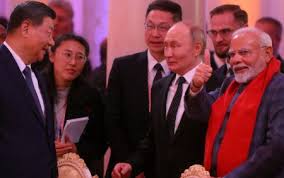
In a show of strength, China’s President Xi Jinping got by his side President Vladimir Putin and Prime Minister Narendra Modi in an event to show that Russia and India can be part of a multilateral, multi-polar order as counter to the one that is dictated by the US today.
That US President Donald Trump’s tariffs-led world order would be challenged was obvious. The load was too heavy, the trade weaponisation policy had no space for friends, the directions were chaotic and the design was pure profit maximisation for America. Such a system had stamps of a ‘school bully’ and, even if accepted, could not have lasted.
China seized the opportunity to push forward an alternate world view, after Trump set out to demolish the US-led global order built after World War II. This is a project Xi has been working on for over a decade and now put it on public display with more vigour at the Shanghai Cooperation Organisation (SCO) event in the Chinese port city of Tianjin on the Bohai Sea. The focus was on expanding cooperation among the 10-member nations and a new development bank was proposed.
The new bank for set up will operate as a concessional lender, structurally run like the BRICS New Development Bank (NDB) and the Asian Infrastructure Investment Bank (AIIB), both headquartered in China and initially floated as a challenge to the US-dominated World Bank and the International Monetary Fund (IMF). In order to give it weight, China has pledged $1.4 billion in loans for SCO members.
China followed this up with its largest-ever military parade in Beijing to commemorate the 80th anniversary of the end of the second world war, with Putin, North Korean leader Kim Jong Un and 24 other heads of state joining the event. Xi in his speech stressed on the need for a more just and balanced global governance system which should shed ‘Cold War mentality’.
Trump responded with a post on Truth Social. “May President Xi and the wonderful people of China have a great and lasting day of celebration. Please give my warmest regards to Vladimir Putin, and Kim Jong Un, as you conspire against the United States of America,” he wrote.
The threat of a cold war is imminent but not drawn out with firm boundaries yet. The China-Russia-North Korea axis is more or less formed and this has drawn in other countries who are anti-American like Iran or are run by authoritarian regimes like Belarus. On the other side are the west European countries which have stayed away from China’s ‘show-of-strength’ summit. At the middle of the spectrum are countries which have been alienated by Trump’s stiff tariffs and are leaning to China at this stage, but could move away with time.
Even as the geopolitical map is getting redrawn, there isn’t so much of polarisation in the external world that would allow a China-led world order to rule as the only counter-weight. Unlike the old rivalry between the US-led capitalist bloc and the Russia-led communist bloc in the aftermath of World War II, the world is not yet ideologically split for a cold war to be reborn. A wind of transactional pragmatism is blowing across the world.
There are overlaps within the camps as they seek their own interests. The European countries and Japan may have done a deal with the US but are looking at other trading spots as Trump is proving to be volatile in setting out terms. Even the US is looking to work with everyone, but at Trump’s terms. As India has learnt during this phase, each nation has to work out its maths and build a wide range of micro trading partners.
A clear divide even escapes the economic directions countries want to adopt. The fossil fuel interest runs common across Russia, America under the Republicans and other oil-producing countries in West Asia while China has made major investments in renewable energy and is the leading producer of electric vehicles. Although the European Union aims to phase out Russian fossil fuels by 2027, it is still living with contradictions in the interim and has not completely shut itself from Russian energy. The supply is coming through indirect channels as well.
Realising that it cannot revive its old relationship with the US, China has just signed a deal with Russia for the construction of a pipeline which will transit 50 billion cubic metres of gas per year from Serbia to northern China via Mongolia. But even while flexing its muscles, China has left room for hard bargaining with the US even as its economy faces slower growth under the shadow of trade war, property slump, weak consumer spending and rising unemployment.
For all the blame due to him, Trump inherited a fractured world even as he sat on the US president’s chair for a second term after a gap. The Russia-Ukraine war as well as Israel’s assault on Gaza had begun during Joe Biden’s tenure as president. The rot in the US-led postwar order had also set in before Trump walked in and he only used it to further disrupt the institutions through his tariffs-led ‘America First’ agenda.
There is little that Biden could change. As Putin continued his attack on Ukraine, he couldn’t even make it be seen as a broader fight between autocratic regimes and those who stood for defending democracy. The hollowness of his ideological leanings got exposed when his government extended unconditional military support to Israel as prime minister Benjamin Netanyahu laid merciless siege of Gaza.
Biden failed to unite a polarised nation or even prevent the influence of an ultra-wealthy “tech-industrial complex” in running America. "Today, an oligarchy is taking shape in America of extreme wealth, power and influence that really threatens our entire democracy, our basic rights and freedom," he would rue in his farewell address, after losing the polls to Trump. But he didn’t do much to halt this oligarchic march.
The billionaires have taken over not just America but are also wielding control in many other countries of the world. Economic inequality is becoming an uncomfortable reality which political leaders will need to tackle.
This socio-economic turbulence is spreading and causing concern. It has just led to the resignation of three prime ministers in quick succession due to a variety of reasons – Shigeru Ishiba in Japan, François Bayrou in France and KP Sharma Oli in Nepal. A year back, Bangladesh prime minister Sheikh Hasina had to resign and flee the country on a helicopter as youth-led protests spread. Similarly, in 2022 Sri Lanka faced political crisis fueled by anti-government protests and economic slump.
The world has drifted away to this state of flux and geopolitical hostility also because of another reason. China has posed as a challenger to the US in terms of economic power, technology and manufacturing. It also monopolises the supply chain of rare earth minerals which is crucial for making electric vehicles, wind turbines and defence equipment and can deeply impact manufacturing in the US, Europe and other parts of the world.
China, however, will find it difficult to rule the world order, despite being a crucial player in the global economy. Without Europe and the US, it will not have the clout to bring about a global governance system acceptable to the other powers. India, which is poised to become the world’s third-largest economy within three years, will always share an uneasy relationship with China due to border conflicts.
Though the world order is breaking, it will fall short of sliding to a cold war. The US, Europe, China and India will need each other to trade with, in varying degrees. China will continue to be relevant due to its supply chain power, cheaper costs and its overarching presence in sectors like automotive, manufacturing, technology and rare earth minerals. The ‘axis of upheaval’, comprising China, Russia, North Korea and Iran, will also co-exist.
In this geo-political muddle, India will have to walk a tightrope as it seeks to balance between the US and China. Even as the US has imposed 50% tariffs on Indian goods, bilateral ties with China have normalised to some extent after going through a rough patch since the troops of both countries clashed in Galwan Valley in eastern Ladakh in 2020. Manufacturing, investments and trade hopefully will get an impetus.
A trade deal with the US, however, will be crucial. The US is India’s largest trade partner, estimated at $131.84 billion in the fiscal year 2024-25. While India’s exports stood at $87 billion, imports were at $45 billion, giving it a trade surplus of $42 billion. India, in contrast, had a trade deficit of $99.2 billion with China from a total value of $127.7 billion in FY25, with imports at $113.5 billion and exports falling to $14.3 billion.
Even with such a huge deficit, the trade with China is invaluable as it consists of a significant volume of components and raw materials, especially in sectors like electronics, pharmaceuticals (APIs), chemicals and textiles. This allows India to use such raw materials like APIs to manufacture and export to countries such as the US. China is also a major exporter of mobile phones, electrical machinery, and telecom equipment to India. The negotiations will now have to hover around narrowing this trade deficit and improving India’s exports to China.
The limitation China has in leading a world trade order is that it cannot fundamentally shift from its status as a net surplus exporter in relation to any partner nation. The scale and lower costs at which it has built its businesses is unrivalled at this stage and fortifies its trade position.
While maintaining a relationship with China, India will need to trade more with America even as efforts are on to diversify its export markets. Some economists have estimated the 50% tariffs to shave off around 1% of India’s GDP, but the impact it will have on labour-intensive and high-value industries such as textiles, gems & jewellery, auto parts and shrimp will be more severe. The software services sector is also deeply wedded to the US market.
The might of America is not just in being the world’s largest economy with GDP pegged at over $30 trillion, way ahead of China’s. Its biggest value springs from the fact that it is the world’s largest consumer market, which other countries target to spur growth in their economies. No other country gives you market access to such a large class of consumers, driven by high disposable incomes and spending power.
China’s spectacular rise to a GDP of $18.74 trillion in 2024 was driven to a large extent by the export market America provided for Chinese goods. Between 2000 and 2021, China’s share of global GDP climbed from 3.5% to 18.5%, and has fallen since then to 16.5% as the relationship with America has come under strain.
In the era of tariffs that Trump is dictating, countries will explore new bloc formations but will also need to have trade outside them. Transactional politics will take over as nations turn inwards and the export-led model gets tougher to succeed.
Cold war will ironically be prevented because of Trump's 'friends and foes alike' tariffs system. But geopolitical hostilities will intensify, with the war in Ukraine continuing and Israel under Netanyahu remaining adventurous. Taiwan, which controls the global semiconductors business, runs the risk of emerging as a new geopolitical hotspot where some sort of military fight can erupt.