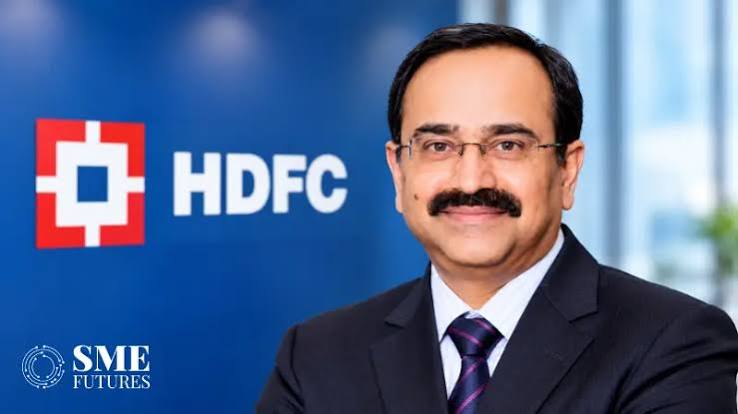
In a rare appointment for the Indian banking sector, a veteran of the country’s second-largest private sector bank has been chosen to head its largest peer lender.
Anup Bagchi, who has spent 34 years at ICICI, has won the approval of the Reserve Bank of India (RBI) to lead and resurrect HDFC Bank, whose shares have hit a low amid governance concerns and post-merger challenges.
Given a three-year tenure as managing director and CEO from 27 October, Bagchi will also have to shepherd HDFC Bank through a crucial period as his former employer, ICICI Bank, rapidly closes in on the leader. The largest private sector lender’s market capitalisation at Rs 11.09 lakh crore is now only 16.8% higher than that of ICICI Bank’s valuation of Rs 9.37 lakh crore, which at the time of the merger was as high as 85%.
The regulator’s preference for an external candidate over Deputy Managing Director Kaizad Bharucha signals the end of an era at HDFC Bank. While Aditya Puri ran the bank for 26 years since its inception in September 1994, continuity was maintained for the next six years by his successor Sashidhar Jagdishan. The chain, however, has been broken now with Bharucha not chosen to occupy the CEO chair, despite having been an insider at HDFC Bank for over three decades.
An independent, extra layer running over the organisational machine of HDFC Bank could help calm investor worries, bring in processes, de-toxify the work environment in certain areas where aggressive marketing practices had brought in lapses, and discard ‘business overreach’ in the system.
A fresh perspective is also needed to change the running gears of the bank in the post-merger era, pivoting around deposit mobilisation, the acceleration of loan growth, net profit expansion and the widening of margins in line with peer banks’ profit.
Analysts say an external wind had to blow in to restore investor confidence, particularly after the abrupt exit of part-time chairman Atanu Chakraborty in March this year citing governance and ethical concerns. They also point out the underperformance of the bank after the merger with its parent mortgage financing company HDFC Ltd.
As an external hire, Bagchi brings in that fresh whiff of air to handle the legacy issues at HDFC Bank. He has a clean slate, as Bernstein’s Pranav Gundlapalle says, to “reset internal corporate dynamics and investor expectations”. He has experience in retail and wholesale banking, capital markets through ICICI Securities, and a three-year exposure in insurance as head of ICICI Prudential Life Insurance.
At the centre of the value that Bagchi brings is that he will have an outsider’s view to tackle the issues that have eroded the valuation premium which HDFC Bank historically enjoyed. According to brokerage firm Bernstein, the bank’s loan growth and return on equity have converged towards system averages.
A leadership change led by an ‘outsider’ could be particularly relevant for a bank navigating a demanding operational and strategic transition, said Suresh Ganapathy, MD and head of India research at Macquarie Capital in a note to investors.
The operational issues have sprung up particularly after the merger in July 2023, which saw the bank inherit HDFC Ltd’s mammoth mortgage book without having in line a matching deposit franchise. The credit-to-deposit (CD) ratio surged to around 110%, inducing the lender to slow loan growth while aggressively chasing deposits.
For a bank that was used to the 30% golden growth era between 2003-2013 and then to the 20% phase in the next decade, the current run rate pales in comparison. Following the mega-merger, the bank’s balance sheet swelled to over Rs 29 lakh crore, making it impossible to maintain its historical growth rates.
Bagchi will have to fix the bank’s net interest margin (NIM) which has contracted to 3.3% in the year ended March 2026 versus 4.1% in 2023. The share of low-cost CASA (current account savings account) deposits in the total mix has fallen to 34.1% for FY26 compared with 44% in 2023, impacting profitability. The other tasks will include lowering the CD ratio to 90% and the cost-to-income ratio to 30%.
While Bagchi’s focus will shift to the post-merger integration stress at HDFC, his former bank has been gaining ground with a stronger NIM, steady loan growth and stable asset quality. ICICI Bank’s annual NIM for FY26 was higher at 4.3% and its CASA ratio stood at 39%.
In improving the bank’s technology architecture, Bagchi's experience of developing ICICI Bank's internet banking and online trading platform will come in handy.
Ganapathy has outlined Bagchi’s priority areas to include: ramping up retail growth, particularly retail unsecured loans; increasing the share of CASA deposits; enhancing the technology architecture; improving the customer service culture; and improving cross-sell ratios.
A major yardstick will be the revival of HDFC Bank’s stock performance, which has been dismal since the post-merger peak market valuation of Rs 15.72 lakh crore. The value has eroded by over Rs 4.6 lakh crore during this period, after a prolonged period of selloff.
The shares have dropped 27% in 2026, marking the stock’s worst calendar-year performance since 2008. On 11 September 2026, it touched a 52-week low of Rs 681.90 compared with a high of Rs 1,020.50 on 23 October 2025. Since then, it has seen a modest rebound to Rs 721.20 but has a long way to go.
The shares of HDFC Bank rose 5.5% on the ADR (American Depositary Receipts) market on 1 October. The response on the domestic bourses is still uncertain as the BSE and NSE stay shut for three days from 2 October.
Investors, however, are hopeful that the shares will take a new turn on 5 October, the first day of trading after the news of Bagchi’s appointment broke out in the evening of 1 October.
The ultimate test will be when Bagchi takes charge by the end of this month and is able to establish the bank’s post-merger strength while ensuring that the share price goes soaring again.