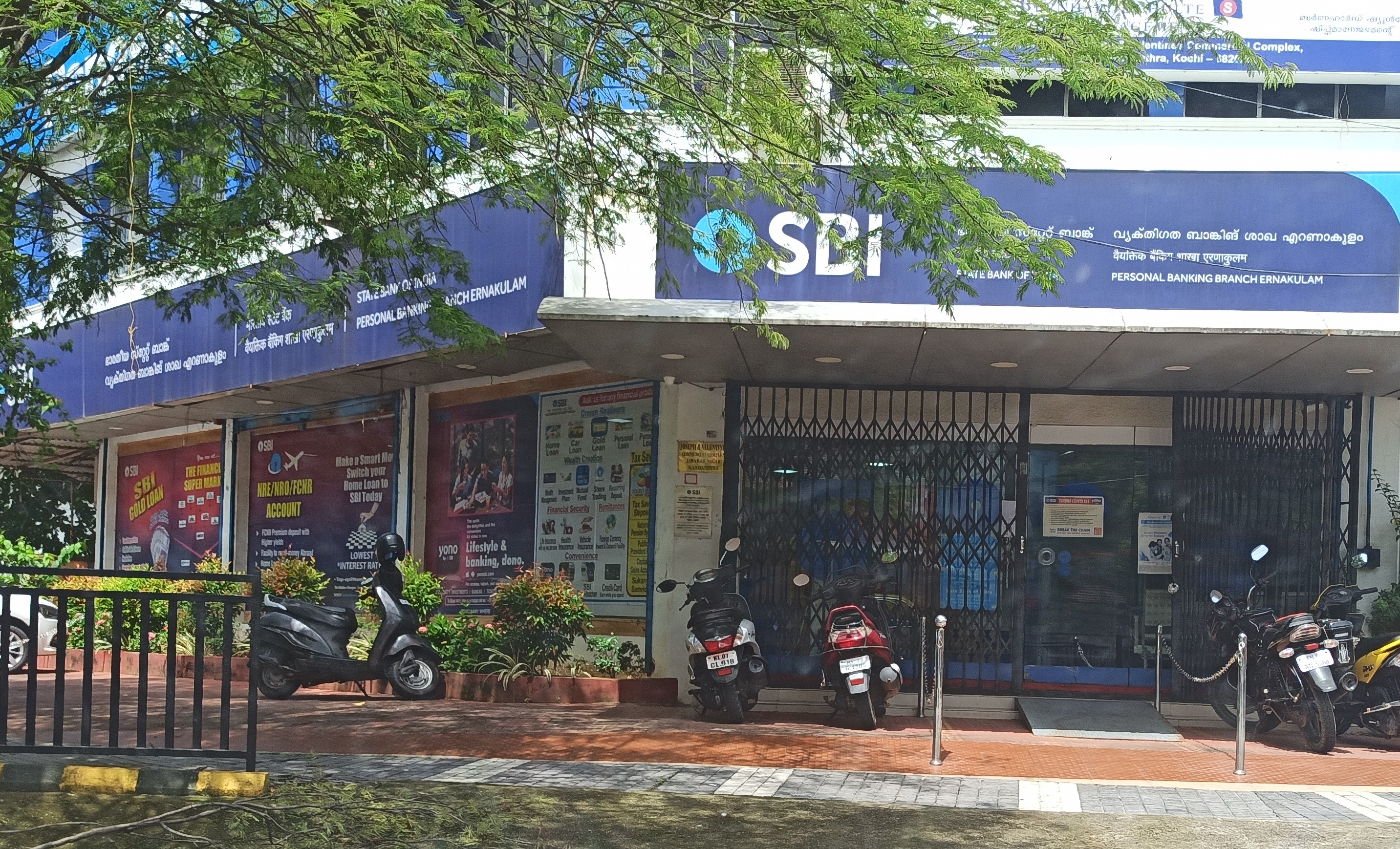
State Bank of India’s 14.28% jump in the September quarter net profit from the year-ago period was led by the sale of its stake in SBI Funds Management, lower provisions and strong growth in net interest income (NII).
The state-run lender, which posted a net profit of Rs 23,038 crore in the fiscal second-quarter ended September, sold a 6.13% stake in SBI Funds Management, which produced a pre-tax gain of Rs 7,288.5 crore in the first half of FY27.
The gain, reflecting in the second quarter, was 59% higher than the Rs 4,593 crore the bank realised from its stake sale in Yes Bank a year ago.
The bank also sold stake in the National Stock Exchange during its initial public offering (IPO) to gain Rs 2,400 crore, but it did not get captured in its profit and loss account. Since SBI’s NSE holding is classified as available for sale (AFS), the divestment gains are routed to the AFS reserve.
Supported by strong loan growth, the lender’s net interest income (NII) in the July-September quarter was Rs 49,143 crore, up 14.69% from the year-ago period.
NIM expands but guidance stays conservative
The bank’s domestic net interest margin (NIM) expanded to 3.11%, up 11 basis points from the previous quarter and by 3 bps from the year-ago period. The NIM growth was driven by lower deposit costs, supported by FCNR(B)-led replacement of high-cost wholesale deposits and improved CASA (current account savings account) balance. The yields on assets also improved as the bank prioritised pricing over growth in corporate loans.
Global NIM increased 8 bps sequentially to 2.94% at the end of Q2FY27, but fell from 2.96% a year ago.
“The fall in cost of deposits and rise in yield on advances helped us to maintain and improve our NIM during the quarter,” said SBI chairman CS Setty.
SBI raised $10.9 billion in foreign currency non-resident (Bank), or FCNR(B), deposits under the Reserve Bank of India’s special swap window, which it used to retire some of its high-cost borrowings.
While guiding for a NIM growth of at least 3% in FY27, Setty said further upside could come from lagged repricing in the external benchmark-linked rate (EBLR) and marginal cost of funds-based lending rate (MCLR). The RBI had in its October policy review raised the repo rate by 25 basis points.
“There could be a gain of 4-5 bps to NIM even if there is some increase or adjustments in deposit rates,” Setty said.
The chief of the country’s largest bank expects the RBI to raise the interest rate by a further 50 bps in the December policy review. “In such a scenario, the EBLR-linked portfolio will be repriced quickly,” he said.
No pressure to increase deposit rates immediately
Setty does not anticipate significant pressure to raise deposit rates as the bank had excess government securities to provide adequate liquidity support for credit growth.
The bank has an excess statutory liquidity ratio (SLR) of Rs 3.5 lakh crore to Rs 3.7 lakh crore currently, compared with Rs 4.8 lakh crore at September-end, providing sufficient liquidity and reducing the need to compete aggressively for deposits.
Credit growth, however, is expected to stay strong across the banking system, which could lead some banks to increase deposit rates. “We will take an appropriate call at the appropriate time,” Setty said.
For the quarter ended September, SBI’s deposits grew 12.27% YoY to Rs 62.78 lakh crore. Domestic deposits stood at Rs 59.95 lakh crore, up 11.83%, with CASA (current account savings account) deposits rising 8.13% to Rs 22.97 lakh crore. The bank’s CASA ratio declined to 38.32% in Q2FY27 from 39.63% a year earlier.
“Deposit growth in Q2 was supported by FCNR(B) mobilisation. Excluding these deposits, growth was around 10.5-10.6%, which is in line with our guidance,” Setty said.
The bank has guided for a 10-11% deposit growth in FY27 and a credit growth of 14-15%.
Loan growth in Q2 stays strong
SBI’s gross advances rose 17.84% YoY to Rs 52.08 lakh crore.
The portfolio comprises 32% EBLR-linked loans, 27% MCLR-linked loans, 17% T-bill-linked loans, and 21% fixed-rate loans, with the balance under other categories.
The bank’s retail loans rose 14.54% to Rs 18.25 lakh crore, while agricultural advances grew 22.64% to Rs 4.51 lakh crore. SME loans rose 21.97% to Rs 6.61 lakh crore, and corporate advances grew 16.12% to Rs 14.39 lakh crore.
“On the asset front, the bank consciously slowed down on lower-yielding working capital and T-bill-linked corporate loans where pricing was unattractive, resulting in lower corporate working capital utilisation,” Emkay Global Financial Services said in a note.
SBI’s ECLGS (Emergency Credit Line Guarantee Scheme) portfolio stood at Rs 28,800 crore, contributing nearly 50% of the bank’s SME loan growth. The management clarified that higher utilisation should not be interpreted as a sign of borrower stress.
Setty said SBI’s estimated ECL (expected credit loss) impact on its standalone loan portfolio is Rs 19,500 crore net of tax, after adjusting for existing provisions and the deferred tax asset (DTA). The estimate excludes certain elements of the ECL framework, including the fair valuation of the HTM (held-to-maturity) investment portfolio and the treatment of crop loans under it, that are yet to be finalised.
The bank’s total business stood at Rs 114.86 lakh crore as of 30 September.
NPA lowest in two decades
Setty said the bank’s gross non-performing asset (NPA) ratio at 1.39% was at its lowest level in more than two decades.
The gross NPA ratio declined by 12 bps from the previous quarter and by 34 bps from the year-ago period.
Net NPAs stood at 0.36% at the September-end quarter, falling by 2 bps from the last three months and by 6 bps from the earlier year.
Provisions
The bank’s provisions for bad loans declined 33% YoY to Rs 2,759 crore in the September 2026 quarter.
Fresh slippages rose to Rs 5,227 crore during the quarter from Rs 4,754 crore a year earlier, but it improved from Rs 7,046 crore in the preceding quarter.