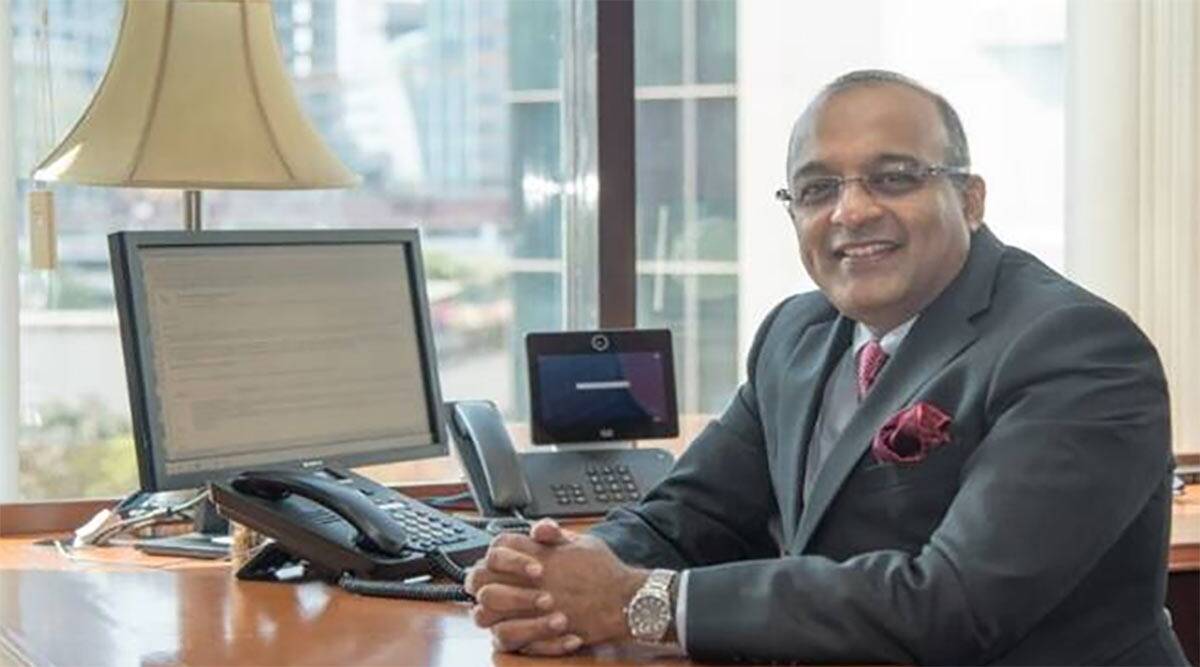
In the autumn of 2020, Sashidhar Jagdishan turned emotional when he took upon himself the responsibility of making Aditya Puri’s exit the most memorable farewell a chief executive could have to mark his legacy at an institution he built from its startup stage.
It was a mix of adoration, hero-worship and public praise for a boss who had led HDFC Bank to pole position among the private sector lenders in India. Some critics even called it open flattery.
“You are one in a billion. There will not be anyone like you. We will miss you," he said while welcoming Puri to his last analyst call after the bank announced its fiscal second-quarter results.
Six years later, in the same month of October and during the second-quarter results, Jagdishan turned emotional again as he addressed analysts for the final time. Nine days later, he would hang up his boots to end a 30-year innings at HDFC Bank.
“While leaving this organisation is an emotional moment for me personally, I take comfort in the fact that I'm leaving behind a solid platform,” he said.
The truth is that Jagdishan hadn’t designed a farewell that early, and he was not leaving behind a bank in the best of shape.
He was “willing and raring to go” for a third term as managing director and CEO of a bank which he had joined in 1996 as a manager in the finance department. He fought back remarks made by part-time chairman Atanu Chakraborty in his mid-March resignation letter that “certain happenings and practices within the bank” were “not in congruence with my personal values and ethics”.
But somewhere in this uncertain turf, he gave up. Feeling the heat of events unfolding and the appointment of former chief election commissioner Rajiv Kumar as part-time chairman in July, he decided not to seek an extended term as CEO despite having the support of the board.
By then, the bank was slipping. Several measures were taken but nothing seemed to turn around the investors’ confidence. The bank’s market capitalisation eroded sharply, with per share value hitting a low of Rs 688 after touching a 52-week high of Rs 1,017.90.
The slump came in the midst of governance lapses, mis-selling of Additional Tier-1 (AT-1) bonds of Credit Suisse at the lender’s Dubai branch, and the MSRDC (Maharashtra State Road Development Corporation) deposits issue. The US-Iran conflict, the surge in global oil prices, the flight of foreign capital from Indian equities and the post-merger complexities of integrating mortgage financier HDFC Ltd with the bank added to the problems.
As the chief, Jagdishan rode HDFC Bank through a turbulent phase. In his final address to analysts, he brushed through some of these. “The bank has demonstrated strength and resilience to navigate regulatory embargoes, an unprecedented Covid event, a large, complex merger when the economic outlook warranted monetary tightening and other governance matters of the recent past,” he said.
Jagdishan faltered on some of these occasions even as he presided over 210,000 employees and an HDFC Bank brand “that binds its 100 million customers”. On issues like digital outages, it would be wrong to put the blame on him as he inherited them from his predecessor. On the mammoth merger matter valued at a whopping $40 billion, he had to swim through the complexities and challenges. But at the end of it all, it was a mixed innings with tasks begun which his successor has to re-evaluate and carry forward.
The main challenge for Anup Bagchi, who takes guard as the first CEO from outside the organisation, will be to revive the bank’s share price. The credibility and reputation of the bank from the investors’ perspective will need to be restored while hoping that the global headwinds impacting the domestic bourses disappear.
A more internal issue will be to see the proportion of retail deposits grow much faster. With the merger loading parent HDFC Ltd’s massive mortgage book onto the bank without a matching deposit franchise, much of Jagdishan’s effort since 1 July 2023 has been to chase deposits while slowing loan growth to bring the credit-to-deposit ratio down from 110%. The situation has progressively improved since then but Bagchi will have to continue with the balance-sheet repair work, probably with his own strategies.
As part of this exercise, Jagdishan certainly stepped up the liabilities engine with rigour, substantially scaling up the bank’s branch network. The lender added 1,885 net branches between 31 March 2023 and 30 September 2026, taking the total count to 9,706 as on 30 September 2026 from 7,821 at the final pre-merger fiscal year-end.
“A lot of our distribution, which has doubled over the last five years, will start to mature as we move to the next five years. Our distribution strength will deliver as the vintage of branches mature. The productivity of the branches, or deposits per branch, continues to be very healthy and probably best-in-class in the banking system,” Jagdishan said.
Around 42% of HDFC Bank’s branches are under five years old. The business per branch, comprising deposits and advances, is up from Rs 266 crore in FY23 to Rs 330 crore in Q1 of FY27. According to HDFC Bank chief financial officer Srinivasan Vaidyanathan, branches remain the primary engine for deposit mobilisation and retail and SME (small and medium enterprises) growth.
After slowing down during FY24, FY25 and FY26 due to a rise in fraudulent mule account activity across the banking system, HDFC Bank has resumed stepping up new account acquisitions. “We added about 1.7 million liability relationships in the second quarter, which is 25% higher than Q1 and 33% higher than the fourth quarter of last year. Building on these new acquired relationships and deepening our existing relationships will enable the liabilities engine to step up further in the coming days even as we keep adding newer relationships at a rapid pace,” Jagdishan said.
Bagchi will have to continue working on accelerating deposit growth. The key will also be to increase the share of retail and low-cost CASA (current account savings account) deposits.
“Because our balance sheet is extremely large, and the fact of the matter is we have a good demand across segments, whether it's corporate, whether it's MSME or retail, the need to pick up some of these non-retail liabilities is a given. I think as we restructure and have alternate strategies on the balance sheet, including some amount of non-deposit strategies, I think we probably will have the proportion of retail becoming larger and larger, and it will have a kind of a downstream impact on multiple metrics as well,” the outgoing CEO told analysts in his final conference call.
On the CASA front, there is space to expand as the current nascent branches progress towards maturity. Out of the bank’s presence in 765 districts, in more than 54% of those the market share is 2 to 3 percentage points lower than its average as the branches have yet to move to the maturity stage. So, the expectation is that there is a significant market share opportunity, at least from the statistical model point of view.
“When we split the deposits into retail and non-retail, the retail CASA ratio is a very healthy number. It is reigning in the late 40s - and that's been the kind of average, which is pretty much stable over a long period of time. It's just that the balance sheet has ballooned, post-merger. The fact is that over the last three years, we have had to substitute the borrowing maturities of the erstwhile HDFC Ltd, which is almost about Rs 2.6 lakh crore. This necessitated taking more time deposits,” Jagdishan explained.
Besides, banks are faced with a situation where the incremental accretion to low-cost CASA in the system is shrinking due to a structural shift in household savings.
“Now, when you put all this together structurally, I think this is going to be a systemic issue over a period of time. There may be certain structural adjustments that one needs to do on the balance-sheet side, not just on a one-time basis but maybe on a continuous level to patronise core retail deposits. And alternate ways will have to be found to keep the funding requirements to the bare minimum to ensure that it is far more affordable and does not stretch the system. The CASA ratio needs to be protected,” Jagdishan said, pointing out that all these are his blue-sky thoughts.